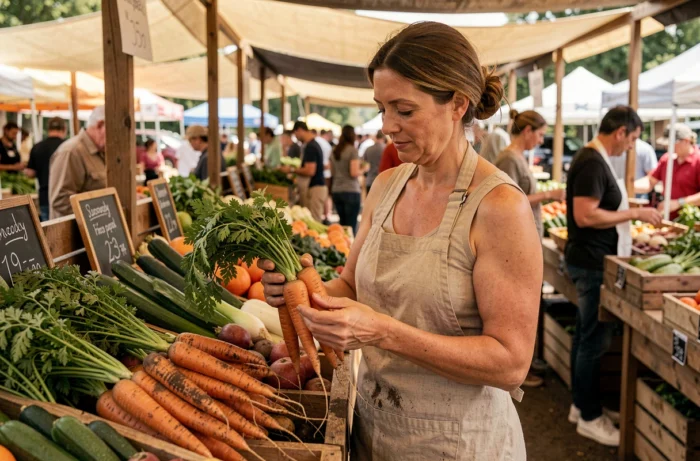
A product labelled “organic” is not necessarily grown nearby, and a vegetable bought at an open-air market may have travelled through several regions before reaching the stall. Understanding the difference between these two concepts, knowing what each label guarantees and learning how to read the label on a processed product all help you make food choices that genuinely align with a responsible approach.
Where processed products come from: what the label doesn’t always tell you
For fresh fruit and vegetables, the country of origin must be stated. The rules change as soon as a food undergoes processing. The origin of ingredients in a processed product is not always listed: the milk in a yoghurt, the flour in a biscuit or the vegetables in a carton of soup may come from countries other than the one where the product was made, without this being specified on the packaging.
The EU’s INCO Regulation requires origin labelling in certain cases (beef, honey and olive oil), but leaves considerable room for ambiguity when it comes to most industrially produced foods. A biscuit labelled “made in France” may contain Ukrainian wheat and New Zealand butter without breaking any rules.
The voluntary Origin’Info logo, introduced recently, offers an additional clue. It identifies the origin of the main ingredients in certain processed products. Its presence on packaging indicates that the manufacturer is committed to transparency, but its absence does not mean the product is deliberately opaque: participation is voluntary.
Some producers and retailers committed to local sourcing provide details of their supply chains directly on their websites. Regional platforms such as https://lafermedumidi.fr, for example, let you trace products back to the farm they came from.
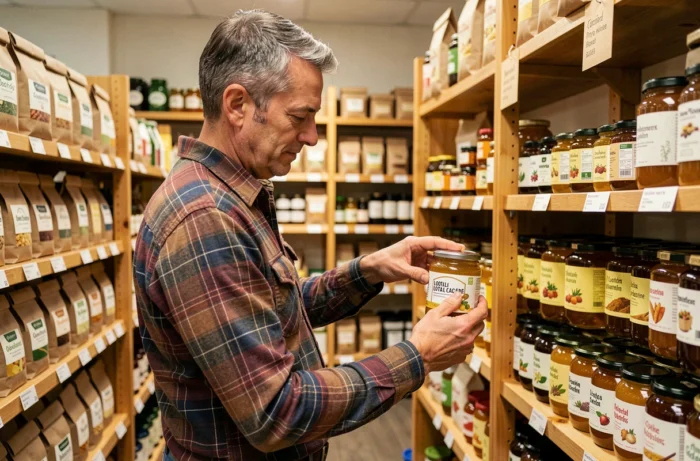
Organic labels and local supply chains: two distinct guarantees that work well together
The AB (Organic Agriculture) label and its European equivalent, the Euro-leaf, certify a method of production: no synthetic pesticides, no GMOs and respect for soil crop-rotation cycles. They say nothing about how far a product has travelled.
By contrast, a short supply chain means that there is no more than one intermediary between the producer and the consumer (farm-gate sales, AMAP schemes or produce boxes). A local supply chain is defined by distance, generally less than 70 km, with no limit on the number of intermediaries.
A food can be organic but not local (an organic banana from Peru), local but not organic (a treated apple sold at the village market), or both. The aim of responsible eating is to combine these criteria rather than prioritise just one.
- For products that can be grown in France (vegetables, seasonal fruit, cereals, meat and dairy products), choosing organic and local reduces both the impact of chemical inputs and the footprint of transport.
- For exotic products (coffee, cocoa, tea and spices), the local criterion does not apply. Organic certification combined with fair trade is the most reliable guide.
- For processed products, checking for the Origin’Info logo or contacting the manufacturer is the only practical way to find out where the ingredients come from.
Food seasonality: the often-overlooked factor in responsible organic eating
Buying an organic tomato in January raises an issue that the label alone cannot resolve. An organic vegetable grown in a heated greenhouse uses far more energy than a conventional vegetable grown outdoors in season. Seasonality directly affects a food’s environmental footprint, sometimes more than the way it is grown.
Following the harvest calendar naturally leads to a more local diet, since seasonal produce available nearby does not need to travel thousands of kilometres or be kept growing artificially. Fruit and vegetables picked when ripe also taste better and have greater nutritional value.
The same principle applies to fish and seafood. Eating species at the right time of year helps reduce pressure on fish stocks and ensures the flesh is at its best.
Organic food sales in France and institutional catering: the state of the market
After several years of decline, at-home organic food sales have increased in both value and volume, according to data reported by Agence BIO in 2025. This turnaround challenges the prevailing narrative that consumers have permanently fallen out of love with organic food.
Results in institutional catering are mixed. The French Ministry of Agriculture’s 2026 reporting campaign shows a persistent gap between legal targets and reported purchases. Primary schools are doing better than other sectors, however: they have exceeded the organic target set by law.
These figures are based on establishments that submitted reports, and their number increases with each campaign. Coverage is improving, but the results do not yet represent all institutional catering in France.
The word “local” does not guarantee where a product comes from
In its fourth edition, published in 2026, the Ytera Observatory points out that the term “local” has no strict regulatory definition. Retailers can describe a product as local according to their own criteria (department, region or a variable kilometre radius). Checking the actual origin rather than relying solely on the word “local” remains the most reliable approach for consumers.
Combining organic certification, seasonality and traceable origin provides a stronger framework than relying on any one criterion alone. Unprocessed fresh produce is the easiest to assess: its origin is displayed and its season is known. For everything else, checking labels carefully and choosing clearly identified short supply chains are the most practical ways to eat responsibly.