French law now provides practical ways to strengthen bonds between generations within families, going well beyond occasional visits. The ELAN Law, in particular, established a formal framework for intergenerational cohabitation, allowing someone aged 60 or over to host a person under 30 under a contract. This contractual framework changes the nature of the family and social relationship between seniors and young people.
Intergenerational cohabitation: understanding the contractual framework
Intergenerational cohabitation is more than an informal family arrangement. Under the framework introduced by the ELAN Law, the parties must sign a written contract setting out the accommodation arrangements and, where applicable, the small services provided by the young occupant. These services must not be provided for profit, ruling out any disguised remuneration.
This framework protects both parties. The senior retains control of their home while benefiting from a reassuring presence. The young person gains access to affordable accommodation. Any financial contribution remains modest and regulated.
One point is often overlooked: having a cohabitant never replaces professional support. When a senior needs day-to-day assistance (care, mobility, administrative tasks), the young cohabitant supplements the support provided; they do not replace it. Confusing the two can leave the young person overburdened and the senior without adequate support.
Families wishing to explore these issues further will find useful guidance on balancing family life with support for older people in IDEOSENIOR’s family section.
Communication between generations: adapting without being patronizing
Each generation tends to use different forms of communication. Seniors often prefer phone calls or letters. Younger people tend to use instant messaging, voice notes and video calls. Insisting on a single channel means excluding some family members.
A practical solution is to identify a channel everyone can use, while also keeping each person’s preferred channels. A family group chat can coexist with a weekly phone call between a grandparent and their grandchildren.
Avoiding two common pitfalls
- Talking down to seniors: simplifying your vocabulary or speaking more loudly without good reason creates distance. Adjusting the pace of the conversation (allowing time to respond and avoiding a barrage of messages) is more respectful than changing the way you speak.
- Information overload: sending dozens of photos or videos without context can lose the recipient’s interest. A short message with a captioned image is more likely to prompt a conversation than a constant stream of content.
- Lack of reciprocity: contacting a senior only to ask for help (childcare, financial support) without taking an interest in their daily life creates an imbalance. Intergenerational bonds are built on mutual exchange, not one-sided requests.
Blended families and intergenerational bonds
Recent Insee data confirm the diversity of family structures in France: blended and single-parent families, as well as grandparents who live far away. Strengthening bonds between generations means adapting what you do to each family’s actual circumstances.
In a blended family, biological grandparents may share family life with step-grandparents. A bond does not form automatically. Creating shared rituals—a monthly meal, a quarterly outing or a joint project—helps build a lasting relationship without forcing an artificial closeness.
When family members live far apart
When generations are separated by hundreds of kilometres, occasional activities are not enough to maintain a strong bond. Two approaches work better than infrequent visits:
First, arrange a regular get-together from a distance: a video call at the same time each week, reading the same book and discussing it, or following a TV series or sporting event together. Consistency matters more than duration.
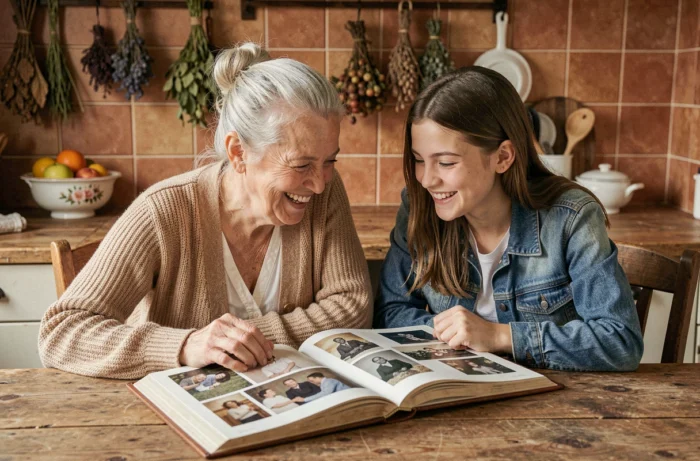
Second, work on a tangible project together despite the distance. Reconstruct a family tree, compile family recipes in a shared notebook, or create a photo album with captions from the senior and layout by a grandchild. A shared project provides an ongoing reason to stay in touch.
Senior isolation: looking beyond the family circle
Isolation among older people is not simply a matter of how often they see their loved ones. A senior may see family every week and still feel isolated if the visits remain superficial or their social network outside the family has faded away.
We find that the most effective approaches combine family connections with opportunities to engage with the wider community. Local associations, community spaces and intergenerational activities at libraries or community centres create opportunities to meet others, complementing family ties without replacing them.
For families, this means providing support: helping the senior identify local resources, accompanying them on their first visit and addressing practical barriers such as transport or registration. Helping seniors access a wider social network is a better safeguard against isolation than simply increasing the frequency of family visits.
Bonds between generations cannot be imposed. They grow through practical arrangements, communication adapted to each person and an understanding of the family’s actual structure. Families that prioritise consistency over occasional bursts of activity build stronger, longer-lasting relationships between seniors and younger generations.