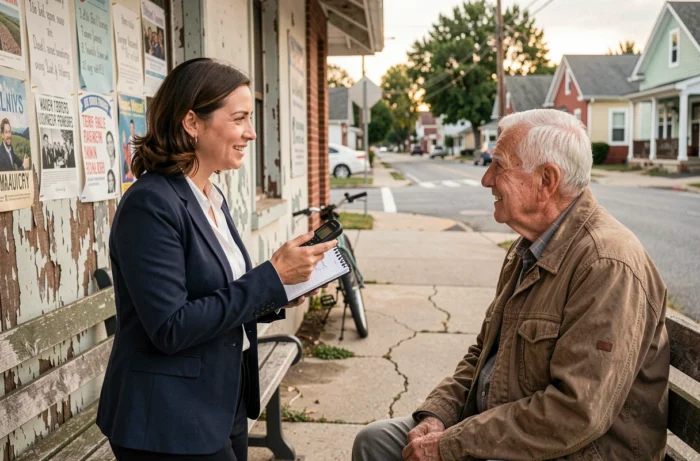
Measuring the impact of local media on a community means looking beyond circulation figures and audience numbers. Local news relies on a fragile ecosystem in which the closure of a retail outlet, the consolidation of a media group or a lack of digital coverage can be enough to cut part of the population off from news that directly affects them.
Physical access to local news: what the closure of retail outlets changes
The weakening of local news is not driven solely by newsroom cutbacks. It is also accelerating as places where people buy a newspaper, meet a local correspondent or read a municipal notice disappear.
When a newsstand, newsagent or local press outlet closes, a tangible point of access disappears. Residents who do not subscribe to digital editions lose their main connection to news about their community. Community ties also depend on the physical presence of media, not just on online distribution.
Platforms such as citizens-news.com are trying to recreate this connection by offering locally rooted news through an accessible digital platform. The question remains whether these new channels reach the audiences who used to visit traditional retail outlets.
Older people, residents of poorly connected rural areas and low-income households are the first to be left out. Without reliable internet access or familiarity with digital tools, the shift to an entirely online model creates a new information divide.

Consolidation of the regional press and pluralism: a picture of the tensions
The concentration of regional newspaper titles in the hands of a few groups is changing the very nature of local news. When a single publisher owns most of the titles in a region, the range of perspectives and editorial voices inevitably narrows.
| Factor | Consolidated regional press | Independent or community-based local media |
|---|---|---|
| Geographic coverage | Wide, but shared across titles owned by the same group | Focused on a specific local area |
| Editorial diversity | Limited by a shared editorial direction | Varies according to the editorial mission |
| Business model | National and local advertising, subscriptions | Grants, donations, volunteers, sometimes subscriptions |
| Access to public funding | Eligible for grants for regional periodical publications | Eligible for the support fund for local media and grants for online political and general news services |
| Digital presence | Developed websites and apps | Often limited to social media or a basic website |
This table highlights a structural imbalance. Consolidation can limit the diversity of voices within a community, even when several titles appear to coexist. Readers who consult two newspapers owned by the same group often find that some of their content is shared.
Public funding and local media
France’s public funding system includes a scheme specifically designed for media rooted in a community. The Ministry of Culture provides dedicated grants for regional and local periodicals, overseas publications, and online political and general news services.
Public support for local news is not limited to print newspapers. Digital-only media can also benefit, provided they meet the criteria for political and general news. This distinction is not widely known among the public or those launching local media projects.
People excluded from local news: groups and causes
The digital transition in local media is creating blind spots. Three groups face the greatest risk of exclusion:
- Older people who lack suitable digital devices or have not developed the skills to navigate an online news site. Their main source of news disappears when the print newspaper is no longer available at a newsstand.
- Residents of rural areas where network coverage is still too poor to load web content reliably. For them, an online-only local outlet is simply not part of everyday life.
- Young people who are disconnected from traditional news channels and get their news through social media, without always recognizing the local source behind a shared post.
These forms of exclusion compound one another. A retiree living in a rural community with a slow internet connection and no nearby newsstand loses access to both print and digital news at the same time.
Social media: a bridge or a barrier?
Social media plays an ambiguous role. It allows local media to reach audiences who never visit their websites. But these platforms’ algorithms do not favor local news content, which tends to generate less engagement than entertaining or controversial formats.
Local media depend financially on platforms whose rules work against them. An article in Le Monde dated November 20, 2026, reports on the introduction of a bill aimed at directing some online advertising investment to political and general news websites. The proposal, which is still making its way through the legislative process, illustrates the tension between digital giants’ capture of advertising revenue and the need to fund local pluralism.

Local communication and social ties: more than just news
A local media outlet does more than report facts. It shapes community life by bringing attention to events, municipal decisions and community initiatives that might otherwise go unnoticed.
This shared function creates a common point of reference. When two residents discuss an article published in the local newspaper, they start from the same information. Local news provides the foundation for civic conversation in a community.
The loss of this foundation does more than create an information gap. It weakens residents’ ability to organize, challenge their elected representatives and understand the issues surrounding a development project or school closure.
Digital local media: what it takes to succeed
Successful digital initiatives share a few practical characteristics:
- A modest physical presence (an office, drop-in hours, a presence at local markets) to maintain ties with people who are not online
- A mixed business model combining subscriptions, public funding and local events
- An editorial focus on a clearly defined local area, rather than an entire department
A digital local outlet with no physical roots risks reproducing the very blind spots it claims to address. A presence on the ground remains what distinguishes local media from an aggregator of regional content.
The future of local news depends on combining digital platforms with a tangible presence. Public funding is available and the tools are accessible, but genuine coverage of a community still depends on the ability to maintain local touchpoints where people live, not just where they go online.