
You just unpacked your boxes in your new home, plugged in your MacBook, and the charging light doesn’t turn on. The charger was left in the old apartment, or the cable has given up during the move. Choosing a suitable USB-C charger for your MacBook isn’t just about grabbing the first block available: the power, the cable, and the charging protocol determine the charging speed and the longevity of your battery.
USB-C Charger Power and MacBook Model: The Direct Link
All recent MacBooks charge via USB-C, but they don’t all require the same power. A MacBook Air equipped with an Apple Silicon chip works very well with a low-power block. A larger MacBook Pro demands significantly more watts to maintain its performance during charging.
Why does this difference matter during a move? Because you might end up using a borrowed charger, an old block found in a box, or an adapter bought in a hurry. If the power supplied is too low for your model, macOS displays a message “Slow Charger” in the battery menu. Your Mac still charges, but at a pace that can become frustrating during setup.
As detailed in the dedicated article on Cyber Journalisme, identifying the exact model of your MacBook before buying a new block helps you avoid paying for an unsuitable charger. To find this information, open the Apple menu, then “About This Mac”: the model name and year will be listed there.
USB-C Power Delivery Protocol: What Your Cable Must Support
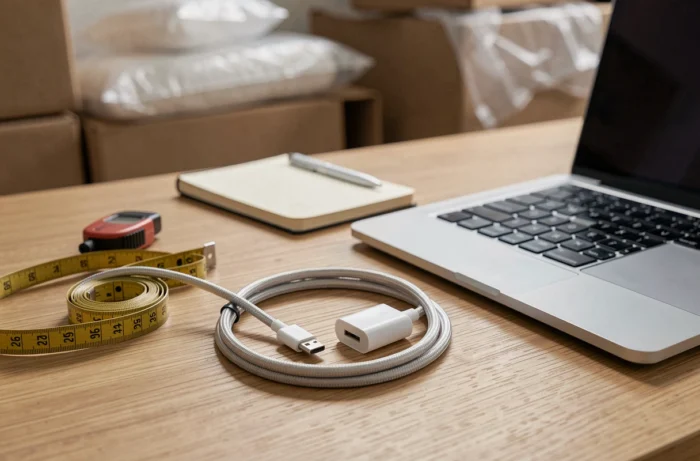
The power block isn’t everything. The cable connecting the charger to the MacBook plays a crucial role as well. A basic USB-C cable, like the one that comes with a phone, doesn’t carry enough power to charge a laptop.
The Power Delivery (PD) protocol automatically negotiates the power between the block and the MacBook. Without this protocol, the Mac receives minimal current, even if the block is powerful. During a move, one tends to use the first cable lying around in a drawer. Make sure the cable explicitly mentions Power Delivery compatibility or that it is an original Apple cable.
Thunderbolt Cable and Standard USB-C Cable
A Thunderbolt cable transmits both high-speed data and high charging power. A standard USB-C cable may be limited to lower power. In practice, a certified USB-C PD cable is sufficient for charging, but if you also connect an external display, a Thunderbolt cable becomes relevant.
Before buying a cable after the move, check the one you already have. Apple indicates compatibility on the packaging or directly on the cable (mention “USB-C Charge Cable” followed by the maximum power).
Fast Charging on MacBook: Real Conditions to Check
Apple offers fast charging on certain MacBook models. This feature allows you to regain a significant portion of the battery in less than an hour, which makes a difference when setting up your office and the available charging time is reduced to a coffee break.
Fast charging only activates if three conditions are met:
- The MacBook model supports this feature (the latest models with Apple Silicon chip are eligible).
- The power block provides sufficient power to trigger fast mode, well beyond the minimum required for normal charging.
- The cable used supports this power, which excludes most entry-level USB-C cables.
An undersized charger will charge the Mac, but never in fast mode. If you buy a new block for your move, choosing a model slightly more powerful than the strict minimum gives you access to this feature without significant extra cost.

Optimized Charging macOS: The False Problem After a Move
You plug in your MacBook in your new office, and the battery hovers around 80%. The natural reflex is to suspect the charger. In most cases, the power block is not to blame.
macOS includes a optimized charging feature that intentionally suspends charging at 80% to preserve battery health over the long term. The system learns your plugging habits and adjusts when it completes the charge. After a move, these habits are disrupted. macOS takes a few days to recalibrate its cycle.
Before buying a charger, open the Battery settings in macOS. If the “Optimized Charging” mention is active, temporarily disable it to check if the block functions normally. This will save you from an unnecessary purchase.
Check Battery Status in macOS
In the Battery settings, macOS also displays the overall status of the battery (maximum capacity, number of cycles). A Mac with a degraded battery will charge slowly regardless of the block used. This check takes a few seconds and guides your decision: replace the charger, the cable, or plan a battery replacement.
European Compliance and USB-C Charger Durability
European regulations now mandate USB-C as the charging port on laptops. This harmonization makes it easier to replace a lost or damaged charger during a move, as compatible blocks are more numerous on the market.
The European requirements do not only concern the connector. They also include criteria for charging compatibility and eco-design. Specifically, a charger compliant with these standards must offer minimal energy efficiency and increased durability.
When buying a third-party charger, check the following points:
- The presence of the CE marking and a recognized safety certification.
- The explicit mention of the USB Power Delivery protocol with the maximum power indicated.
- The declared compatibility with MacBooks (some manufacturers specify this on the packaging).
A no-name charger sold at a very low price presents a real risk: overheating, actual power lower than advertised, or even damage to the Mac’s USB-C port. Prefer a certified charger, even third-party, over a cheap counterfeit.
Moving remains the time when accessories are most easily lost or broken. Choosing a USB-C charger suitable for the power of your MacBook, accompanied by a Power Delivery compatible cable, ensures reliable charging from the first plug-in in your new office.