
In France, nearly two out of three businesses have a website, according to the 2026 France Num Barometer. This rate, which has remained stable for several years, masks a less visible reality: a significant proportion of these sites are rarely updated, poorly secured or legally incomplete.
For a small business, creating a website suited to its activities involves more than choosing a template and publishing a few pages. The key question is what happens after launch, when the site needs to be kept running with limited resources.
Website maintenance: the hidden burden for small businesses
Most website creation guides stop at launch day. The months that follow bring more challenges. A site built on a CMS such as WordPress requires regular updates to its core software, plugins and theme. Every postponed update increases the attack surface for security vulnerabilities.
For a tradesperson, retailer or self-employed professional, technical maintenance is an ongoing cost that is often underestimated. Outsourcing this work means setting aside a monthly budget. Handling it yourself requires understanding security alerts, testing compatibility after every update and knowing how to restore a backup if something goes wrong.
Legal requirements add another layer. Legal notices, a GDPR-compliant privacy policy and a configurable cookie banner must all be in place from launch and updated whenever regulations change. A site that neglects these requirements risks penalties, even if it generates little traffic.
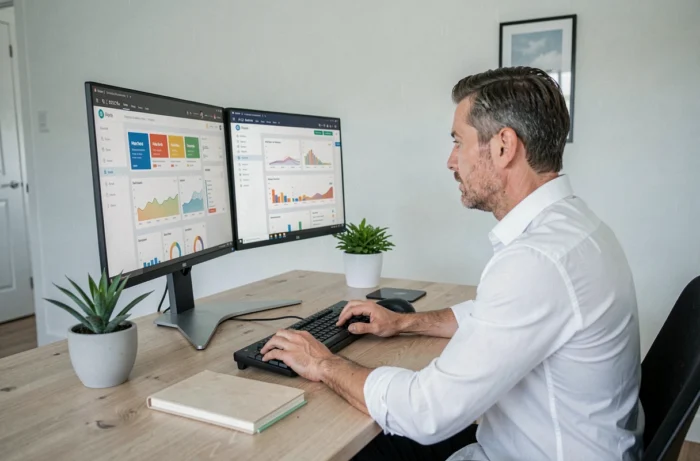
Before choosing a tool or provider, it is worth honestly assessing how much time you can devote to the site each month. A professional with two hours a month to spare has different options from someone who can dedicate half a day each week. The different support plans on the Geekob website illustrate this range, from technical independence to full outsourcing.
Choosing a CMS and page structure: tailoring the site to your actual business
Your choice of website-building tool directly affects future maintenance requirements. WordPress offers maximum flexibility, but every plugin added creates another potential point of failure. Hosted website builders such as Wix or Squarespace reduce technical maintenance by delegating it to the platform, at the cost of more limited customization.
A five- to eight-page brochure website meets the needs of most small businesses. Home page, business overview, services or products, contact page and legal notices. Adding a blog, booking module or online store increases complexity without always delivering measurable returns.
Before adding a feature, ask yourself: who will update and maintain it six months from now? A blog with no posts published in a year gives the impression that the business has been abandoned. A booking module that is no longer synced with the actual calendar frustrates customers.
- For a local service business, a well-maintained Google Business Profile combined with a five-page website is often enough to cover local searches.
- For an e-commerce business, the choice between WooCommerce, Shopify and PrestaShop depends on the number of products, customization needs and monthly technical budget.
- For a consultant or freelancer, a one-page website with a contact form and links to an external portfolio can meet the goal without creating technical debt.
SEO and content: what makes a website truly visible online
Publishing a website does not guarantee visibility in search engines. Organic search rankings depend on technical factors (loading speed, mobile compatibility and tag structure) and editorial factors (how relevant the content is to users’ search queries).
A fast, mobile-friendly website is the minimum technical foundation. Google primarily indexes the mobile version of pages. A design that works on a computer but breaks on a smartphone can hurt search rankings.
As for content, each page should address a specific intent. The “Services” page of a plumber in Lyon serves a different purpose from that of a communications agency in Bordeaux. The vocabulary used, the heading structure and the inclusion of practical information (service area, opening hours and indicative prices) directly affect rankings for local searches.
Publishing less content that is accurate and up to date is better than filling a blog with generic articles. Search engines are getting better at detecting pages with little added value. Three well-written pages with verifiable information can rank better than a dozen empty ones.
Security and updates: protecting a website without a dedicated technical team
Automated attacks target websites of every size. Popular CMS platforms attract particular attention from malicious scripts because they are so widely used, making known vulnerabilities in outdated versions easy to exploit.
Three measures can significantly reduce risk without requiring advanced skills:
- Enable automatic updates for the CMS and critical plugins. If the site generates direct revenue, check compatibility in a test environment first.
- Set up automatic weekly backups stored outside the hosting server so you can restore the site if it is compromised.
- Use an SSL certificate (HTTPS) and keep installed plugins to the bare minimum, as every additional plugin is a potential entry point for attackers.
Removing an unused plugin reduces risk more than adding one specifically for security. Reducing the attack surface remains the most effective approach for websites managed with limited resources.
An effective website is not one that is packed with features at launch. It is one that remains up to date, accessible and compliant twelve months later. For a small business, building a website is a one-off investment, but maintenance requires an ongoing commitment of both time and money. Sizing the site to match your actual capacity to maintain it remains the most reliable decision-making criterion.