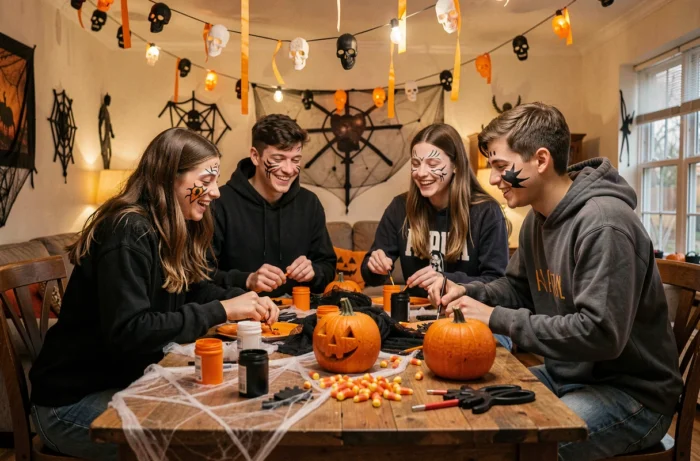
A successful Halloween party for teens is built around a principle that’s often overlooked: getting the scare level right. A group of ten teenagers will always include at least two or three very different personalities—some want to scream in the dark, while others would rather carve pumpkins and chat. Organizing the party around this range of scare levels, instead of forcing everyone into the same format, can completely change the atmosphere of the evening.
Scare-level scale: structure the evening by intensity
The idea is simple: rate each activity on a scale of intensity, then let guests move freely between them. Three levels are enough to suit everyone without leaving anyone with nothing to do.
The low-intensity level brings together creative activities without jump scares: a special-effects makeup station, pumpkin carving, and making paper decorations. These activities aren’t just there to fill time. They offer a place to unwind for anyone who needs a break after something intense, and a comfortable starting point for more reserved guests.
The middle level offers suspense without sensory overload. A cooperative themed board game (such as Mysterium or Betrayal at House on the Hill), a scripted murder mystery party, or a horror quiz with a buzzer all fit the bill. The tension builds, but no one gets hit with a jump scare.
The high-intensity level is for volunteers only and features immersive activities: a walk through the dark, a timed at-home escape game, or a horror movie screening in a separate room. Anyone who wants to leave this level can join the others without having to explain why.
In practice, set up the three levels in separate areas of the house. Turn the living room into the creative zone, use a bedroom for board games, and transform the garage or garden into an immersive zone. Letting guests move freely between these spaces removes the social pressure that can make some teens stick with an activity they aren’t enjoying.
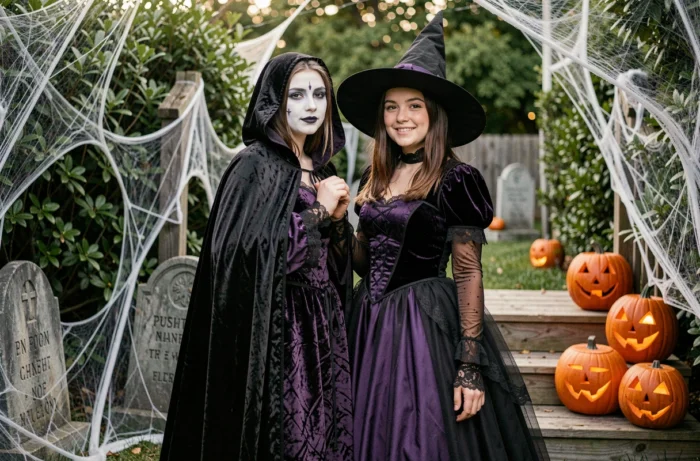
Creative Halloween activities for teens: beyond the classic pumpkin
Creative workshops work best when you offer Halloween activities for teens that feel different from the ones they did when they were eight. Pumpkin carving is still a great option, but only if you raise the bar.
Offer detailed carving templates—geometric patterns or intricate silhouettes—instead of the usual triangular face. A low-cost set of linocut carving tools can help teens create results they’ll want to photograph and share.
Special-effects makeup is always a hit with teens of all genders. All you need is liquid latex, fake blood, and a few tutorials on a screen. Set up a mirror at each station and provide makeup remover to avoid queues. This kind of workshop naturally gets people interacting without forcing anyone to socialize.
Another underused option is making paper and fabric decorations, with a shared end result in mind. Create a wall of garlands made from cut-out ghosts, or a black-paper bat archway at the entrance. The group builds a backdrop together, then uses it for photos.
At-home Halloween escape game: amateur storytelling and game design
The at-home escape game is one of the most frequently mentioned ideas, but it’s rarely explained beyond the basic concept. Success depends on three technical elements that most guides overlook.
Set the right duration and difficulty for teens
An effective DIY escape game lasts between thirty and forty-five minutes. Any longer and concentration starts to fade while frustration builds. Five to seven puzzles, arranged in a sequence that gradually increases in difficulty, make a good framework.
A common mistake is making the puzzles too abstract. Teens respond better to hands-on challenges: combination locks, messages revealed under black light, and objects hidden around the room. Each solved puzzle should produce a tangible result, such as a chest opening or a clue appearing.
Storyline and sound design
The theme sets the scene. A simple but coherent storyline—escaping a mad scientist’s lab or finding a spellbook before midnight—is better than a jumble of references. A two-minute introduction, read aloud or recorded, helps establish the setting.
Sound design matters just as much as the decorations. Play ambient sounds—creaking, wind, whispers—continuously through a Bluetooth speaker to turn an ordinary room into a convincing setting. Dim lighting, such as LED candles and orange string lights, completes the effect safely.
- Plan a system of progressive hints: after five minutes of being stuck, give the group a verbal hint, followed by a written one if needed, so they don’t lose interest
- Choose a game master to stay outside the room, keep an eye on the timer, maintain the pace, and hand out hints
- Give every participant an active role: make sure each puzzle can only be solved by combining clues held by different players, so one teen can’t take over the whole game
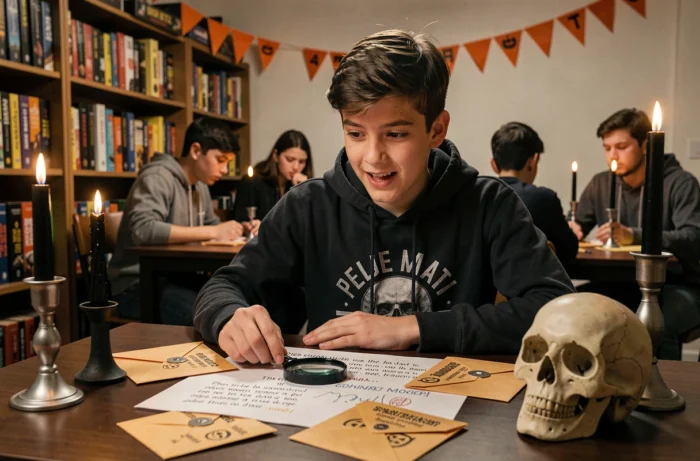
Halloween party food and atmosphere for teens: the details that make all the difference
The buffet isn’t an activity in itself, but it helps structure the transitions between intensity levels. A teen coming back from a walk through the dark needs a relaxed place to regroup. The buffet provides just that.
Presentation matters more than complicated recipes. Finger-shaped pretzels, cupcakes with green frosting, and caramel apples are all easy options: simple recipes with a polished look are all teens need. Candy is another classic worth including, arranged in jars labeled “potions” or “witch’s ingredients.”
When it comes to the overall atmosphere, two common mistakes can bring a party down. The first is a playlist that leans too heavily on “scary sounds,” which gets old after twenty minutes. Alternate between Halloween background music and songs the teens actually listen to to keep the energy up. The second is lighting that’s so dark people can’t interact. Dim lighting works in the immersive zone, not in the main space.
- Set up a photo corner with props—hats, masks, themed frames—where teens can drop by naturally and make shared memories
- Put out a small costume station for anyone who arrives without a costume, with simple items such as capes, fake blood, and headbands
- Keep a quick game on hand (Werewolf or a Halloween-themed version of Jungle Speed) to get things going again if the energy dips between main activities
A successful Halloween party for teens isn’t about how many activities you plan. It’s about letting guests move freely between activities with different scare levels, and making sure each one is well executed. Three well-prepared activities, paired with a thoughtful buffet and a cohesive soundscape, will always make for a better party than eight poorly planned ones.