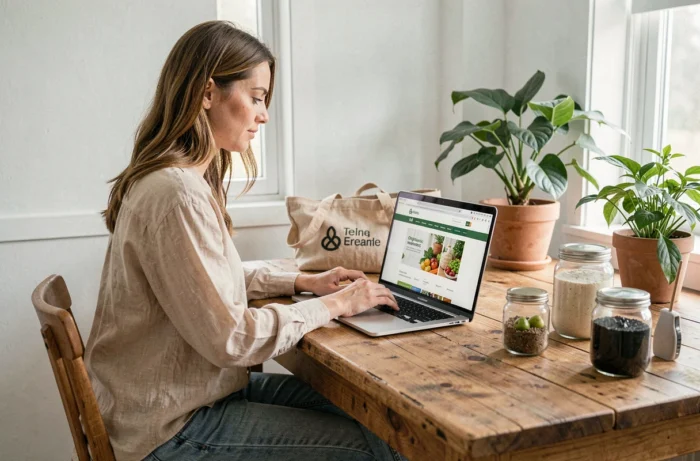
Online organic shopping competes with dozens of platforms that have very different pricing models: annual subscription, free delivery under certain conditions, permanent low prices. Comparing these offers requires looking beyond the displayed catalog. What criteria truly separate online organic shops, and which ones have the most impact on the final basket?
Comparison of the main online organic shopping sites
The differences between platforms are not limited to the number of references. The business model (membership or free access), the threshold for free delivery, and the depth of the range in fresh products create concrete differences on the bill.
| Platform | Access Model | Free Delivery from | Main Range |
|---|---|---|---|
| Greenweez | Free access + loyalty card | Variable depending on offer | Grocery, hygiene, baby, fresh |
| La Fourche | Paid membership | Member threshold | Grocery, cleaning, beauty |
| Kazidomi | Monthly subscription (K+) | Member threshold | Grocery, beverages, baby |
| Etiketbio | Free access, no subscription | €19 at pickup point | Grocery, oils, dried fruits |
| Naturitas | Free access | €39 | Supplements, care, cosmetics |
The threshold for free delivery at Etiketbio, set at €19, remains among the lowest on the market. For a modest basket in grocery or hygiene products, this threshold changes the game compared to a platform that requires double.
To explore other natural and eco-friendly references in addition to these brands, the Zaturelle.com website to discover brings together a selection focused on health and well-being.
Subscription or free access: how the pricing model affects organic prices
La Fourche and Kazidomi operate on the same principle: the member pays a subscription (monthly or annual) to access reduced prices on the entire catalog. This model is profitable from a certain monthly purchase volume. Below that, the cost of membership cancels out the savings on products.
Platforms without subscriptions (Greenweez, Etiketbio, Naturitas) display slightly higher unit prices. Their advantage appears for occasional buyers or those targeting a specific category: natural care, organic oils, baby products.
Two questions help to decide:
- Does your monthly organic basket regularly exceed the threshold at which the subscription becomes profitable? If yes, the membership model reduces the overall cost.
- Do you shop on multiple sites according to categories (grocery on one, beauty on another)? In this case, multiplying subscriptions strains the budget, and free access offers more flexibility.
- Is home delivery necessary, or is a pickup point sufficient? The thresholds for free delivery differ significantly between these two options.
The subscription model favors large regular baskets, while free access is better suited for occasional or targeted purchases in one category.
DGCCRF checks: verifying the reliability of an online organic seller
Price and catalog are not enough. The DGCCRF published a report on its checks conducted in 2024 and 2025 in the organic sector. Several types of shortcomings are documented: absence of seller certification, labeling defects, or unsupported claims of “reasoned cultivation.”
One case noted concerns an online reseller of fruits and vegetables whose mention of “reasoned cultivation” was not based on any verifiable document. This type of deviation reminds us that ecological vocabulary does not replace certification.
For a buyer, three concrete checks reduce the risk:
- Does the site display an organic certification number (certifying body like Ecocert, Bureau Veritas, Certipaq)? This number should be visible in the legal notices or on product sheets.
- Do the products carry an official label (AB, Euroleaf) and not just a simple mention of “natural” or “green” without a reference framework?
- Does the labeling mention the origin of the ingredients and the place of processing? DGCCRF checks often point out frequent gaps in these mentions.
The major platforms mentioned above (Greenweez, La Fourche, Kazidomi) work with certified suppliers and display the labels on their product sheets. The risk increases with small resellers or general marketplaces that aggregate third-party sellers.

Packaging and the AGEC law: the eco-responsible angle beyond the organic label
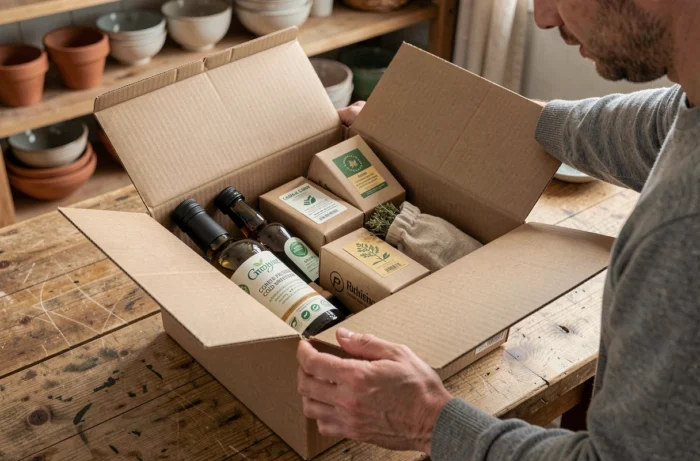
An organic certified product can arrive in plastic over-packaging. The eco-responsible dimension of online shopping also depends on logistics. The AGEC law imposes progressive deadlines on e-commerce players: reduction of single-use plastic packaging, obligation to inform about recyclability, and development of bulk or reuse.
In practice, online organic shops do not all apply these requirements at the same pace. Some already offer deposit options or reduced packaging, while others stick to the minimum regulatory requirements.
The Agency Bio reported a recovery in organic consumption in value in the first half of 2026, following 2025. This dynamic benefits online brands that capture an increasing share of purchases. The question is no longer just “where to find organic products online,” but which platforms combine reliable certification, controlled prices, and sober logistics.
The most discriminating criterion remains ultimately the consistency between the catalog, the pricing model, and the packaging practices. A site that displays competitive organic prices but ships each item in an oversized individual box contradicts the eco-responsible promise. Cross-referencing the product label, the actual cost after delivery, and the packaging policy gives a more accurate picture of what an online organic shop is truly worth.