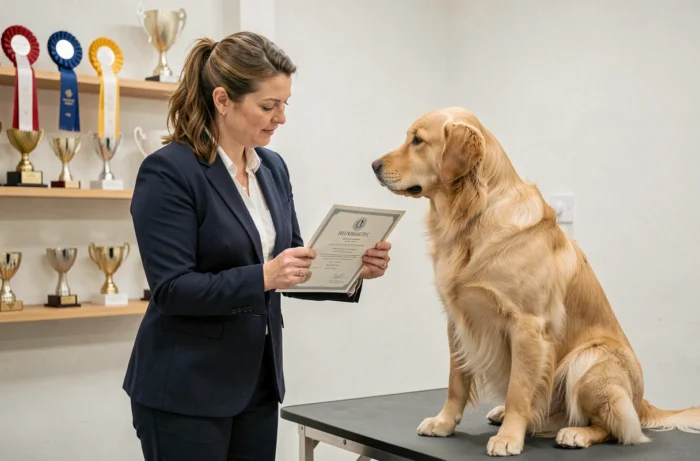
A dog whose two parents belong to the same breed registered in the French Stud Book (LOF) does not automatically have a pedigree. This misconception leads to misunderstandings when buying a puppy, even among well-informed buyers. The distinction depends on a specific administrative process, in which each step—provisional registration, litter declaration and confirmation—produces a different document with a distinct legal status.
Birth certificate, confirmation and pedigree: three LOF documents not to be confused
A dog’s administrative journey through the LOF involves three milestones that many prospective owners conflate. At birth, if the breeder has declared the mating and then the litter to the Société Centrale Canine, each puppy receives a provisional birth certificate. This document confirms that the puppy was born to parents registered with the LOF, but it is not a pedigree.
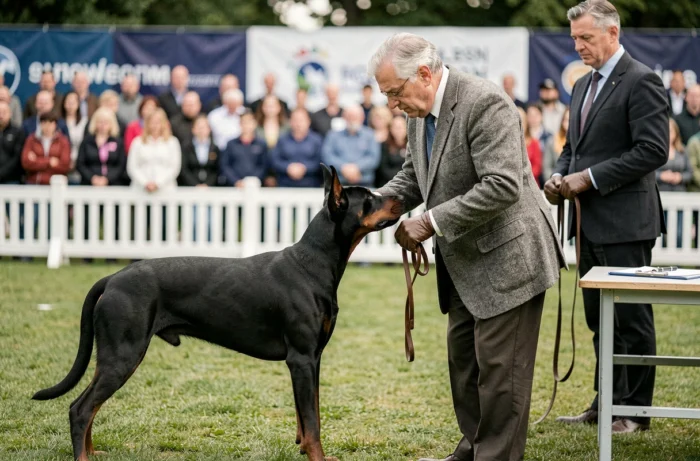
Confirmation takes place later, from twelve months of age for most dogs and fifteen months for certain breeds. An authorized judge assesses whether the dog conforms to the breed’s physical standard. If the dog meets the criteria, it receives permanent LOF registration and, by extension, its pedigree. A dog that has not been confirmed remains provisionally registered: legally, it is a dog “registered with the LOF,” not a “purebred” dog in the full regulatory sense of the term.
The distinction between purebred dogs and dogs with a pedigree therefore comes down to this timeline. At the time of transfer, the puppy has a birth certificate, not a final pedigree. A buyer who insists on “a dog with a pedigree” when the puppy is handed over is making a request that is technically impossible to meet at that stage.
Purebred dogs without pedigrees: what French regulations say
In France, only a dog registered with the LOF may legally be described as a “purebred dog.” A dog born to two LOF-registered German Shepherd parents cannot be sold as a purebred dog if the litter was not declared. On the transfer documents, it must be described as a German Shepherd “type” or “appearance.”
This distinction has direct consequences for the sale price and the buyer’s legal remedies. A breeder who sells a puppy as “purebred” without effective LOF registration would be committing a commercial offense. The term “purebred” has legal standing only when backed by registration in a recognized stud book.
A common pitfall involves litters born to LOF-registered, confirmed parents when the breeder has failed to declare the mating or has done so late. Parents with pedigrees do not prove that their litter is registered with the LOF. Each litter requires a separate declaration to the SCC within the required time frame. Without this step, the puppies are born “outside the LOF,” despite their parents’ pedigrees.
LOF registration and dog health: what a pedigree does and does not guarantee
A pedigree traces a dog’s ancestry over several generations. It can reveal repeated bloodlines and therefore help assess the risk of inbreeding in a litter. This information is valuable to buyers familiar with the hereditary conditions associated with a particular breed.
However, LOF registration does not attest to breeding conditions or socialization, nor does it guarantee that a dog is free from disease. An LOF-confirmed dog may carry hip dysplasia, heart disease or an inherited eye disorder if the relevant screening tests have not been carried out or required by the breed club.
To assess a puppy’s health, several sources of information should be considered together:
- The pedigree, which can help identify close inbreeding among the generations shown
- The parents’ screening results (hip and elbow dysplasia, DNA tests for breed-specific diseases), which the breeder should provide on request
- The veterinary health certificate issued at the time of transfer, which documents the puppy’s condition at the time of sale but does not cover latent conditions
- The breeder’s selection practices, which can be checked with the breed club affiliated with the SCC
A pedigree is a genealogical tool, not a health certificate. Confusing the two remains the main source of disappointment when buying a dog.
Crossbred dogs, dogs of a particular type and LOF-registered dogs: clarify the terminology before adopting
Terminology used in sales listings often causes confusion. Three categories should be clearly distinguished.
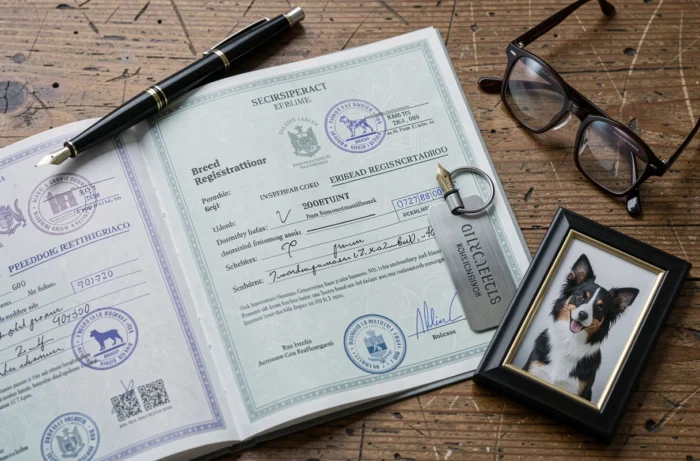
A purebred dog is registered with the LOF, either confirmed or awaiting confirmation. The seller must provide the LOF birth certificate when the dog is transferred. A dog “of a particular type” resembles a breed in appearance but is not registered in the stud book. A crossbred dog is born to parents of different breeds or to unidentified parents.
Genetically, the distinction between “type” and “breed” may seem artificial. A Labrador-type dog may share the same genetic heritage as an LOF-registered Labrador. The difference is strictly administrative and legal. It determines whether the breed name may be used in a listing, whether the dog can take part in dog shows and how its breeding potential is rated.
For adopters who do not plan to breed or enter their dog in competitions, the question takes on a different dimension. A dog of a particular type or a crossbred dog does not have traceable ancestry, making it harder to anticipate hereditary health risks. On the other hand, the genetic diversity of crossbred dogs statistically reduces the risk of certain conditions associated with inbreeding, as shown by several studies cited by the veterinary community.
Choosing between an LOF-registered dog and a dog without papers is therefore not simply a matter of prestige. It involves practical trade-offs concerning the predictability of temperament, health monitoring and purchase price. In every case, checking that the puppy’s LOF birth certificate is provided at the time of transfer should be the first step when dealing with a breeder advertising a “purebred” dog.