A maintenance technician receives an alert on his tablet: a production line motor shows signs of abnormal wear, detected by an embedded sensor that processes data locally, without going through the cloud. This scenario, still rare a few years ago, illustrates the direction that technological innovation is taking in 2026.
Advancements are no longer measured solely by the raw power of algorithms, but by their ability to operate under constraints, whether they are energy, regulatory, or operational.
Edge AI and local data processing: the end of all-cloud
In an industrial site or an autonomous vehicle, sending every piece of data to a remote server poses a problem of latency and bandwidth. Edge AI addresses this constraint by moving intelligence directly onto the terminal, sensor, or machine.
This principle is found in ultra-low-power chips capable of running reduced machine learning models (TinyML). A vibration sensor on a compressor can thus detect an anomaly and trigger an alert without a network connection. The gain is not only technical: it reduces dependence on cloud infrastructures, whose energy cost is becoming a significant issue.
Players like Blog Tech FR regularly document these developments, particularly the rise of hybrid architectures that combine local processing and deferred synchronization with the cloud.
The current limitation of edge AI lies in the size of compatible models: complex tasks (long text generation, high-resolution video analysis) remain too heavy to run on an embedded microcontroller, which varies significantly depending on the type of sensor and the data acquisition frequency.

AI’s electricity consumption: a structural constraint
According to the International Energy Agency, electricity consumption in data centers increased in 2025, and that of AI-focused installations rose even faster. Efficiency gains per task are not enough to offset the overall rise in demand.
In practical terms, this means that deploying a new generative AI model requires securing an electricity supply even before discussing algorithmic performance. For companies using AI solutions in production, the energy cost becomes a selection criterion on par with model accuracy.
This energy pressure accelerates two parallel movements:
- The development of more compact models, optimized to consume fewer computing resources for equivalent results, often through distillation or quantization techniques.
- The use of edge computing, which distributes the load and avoids systematically relying on centralized data centers.
- The relocation of data centers closer to renewable energy sources, including in France where several projects of this type are currently under study.
European regulation: cybersecurity and AI under concrete obligations
The European Cyber Resilience Act took a step forward in 2026 with the implementation of its reporting obligations. Manufacturers of connected products must now quickly report exploited vulnerabilities to ENISA and national incident response teams.
This regulation does not only concern new products: it also applies to equipment already on the market. Managing vulnerabilities post-market launch thus becomes a continuous process, not just a simple check before delivery. The broader general compliance regime is scheduled for December 2027.
AI Act: a readjusted timeline
On the side of artificial intelligence regulation, the European timeline has seen a readjustment. New prohibitions are planned, particularly on the generation of non-consensual intimate images and child sexual abuse content. For companies developing or integrating AI systems, these rules alter the product roadmap well before their full implementation.
In practice, legal and technical teams are increasingly working together from the design phase. Documenting a model’s compliance from the training stage is cheaper than doing it after deployment.
Industrial IoT and digital twins: from sensor to virtual replica
The Industrial Internet of Things (IIoT) is no longer just about connecting machines. The added value now lies in the interpretation layer: cross-referencing data from multiple sensors to feed a digital twin, that is, a virtual replica of equipment or a production line.
A digital twin allows simulating the effect of a parameter change (speed, temperature, rate) without interrupting actual production. The results of the simulation then guide on-site decision-making. This coupling between real-time sensor data and predictive modeling reduces unplanned downtime and extends the lifespan of equipment.
The sectors that are adopting these technologies the fastest are those where production stoppage is costly: aerospace, energy, pharmaceutical industry. In these environments, the reliability of the sensor network is as critical as the quality of the digital model itself.
Natural interfaces and extended reality: beyond the headset
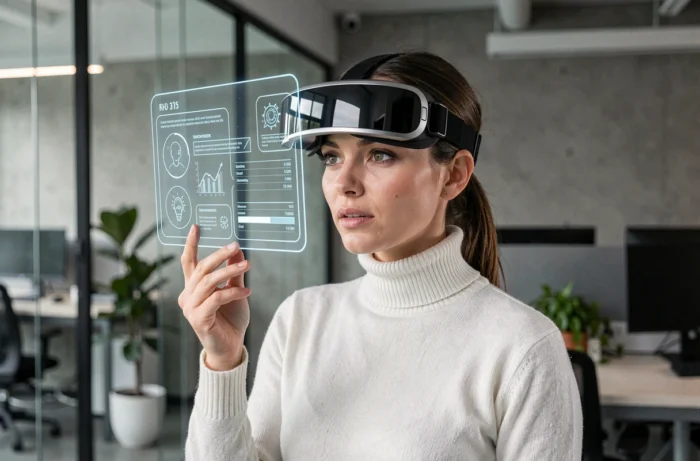
Augmented reality is progressing towards less cumbersome formats. Smart glasses capable of projecting information into the field of view are approaching daily professional use, particularly for maintenance and logistics.
What changes in 2026 is the convergence with natural interfaces: gesture recognition, eye tracking, contextual voice commands. An operator can navigate technical documentation without putting down their tool. The barrier is no longer hardware, but software integration with the company’s existing systems.
Technological innovation in 2026 is less about spectacular announcements and more about the ability to make solutions work under real constraints. Limited energy, active regulation, interoperability between old and new systems: the companies that benefit from these trends are those that address these concrete frictions, not those waiting for the next breakthrough.