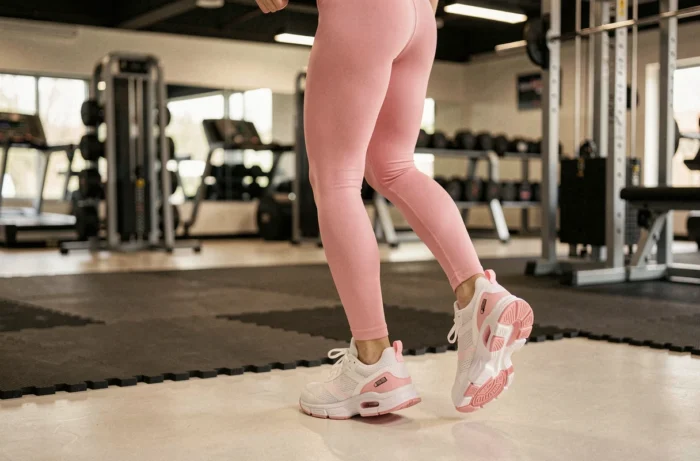
Cushioning, stability, lateral support: these three parameters do not respond to the same biomechanical constraints during a fitness session. Choosing a women’s fitness shoe with cushioning requires understanding when this cushioning is useful and when it becomes a hindrance. The most popular models do not tick the same boxes depending on whether the session revolves around cardio, strength training, or a mixed format.
Cushioning and stability in women’s fitness: two opposing requirements
A highly cushioned sole absorbs impacts during jumps, strides on a treadmill, or sequences of burpees. In this type of effort, the thick foam reduces joint stress at the knees and ankles.
During a loaded squat or deadlift, this same foam compresses under load and creates measurable lateral instability underfoot. The heel sinks asymmetrically, the knee loses alignment, and the force transmitted to the ground decreases. A flatter and firmer sole produces the opposite effect: less comfort upon landing, but a solid base for pushing heavy weights.
Most so-called versatile women’s fitness shoes attempt to strike a balance between these two poles. This compromise works for mixed sessions (circuit training, group classes combining cardio and strength). It does not replace a running shoe for long treadmill sessions or a weightlifting shoe for heavy movements. This point is rarely explained in competing selections, which present versatility as an advantage without specifying its limits.
To refine this choice according to the models on the market, our guide to women’s fitness shoes details the technical characteristics of each pair.
Comparison of women’s fitness shoes: cushioning, weight, and primary use
The table below groups the models mentioned in the main selections on the market. The data concerns the type of sole, usage profile, and relative cushioning level.
| Model | Brand | Cushioning Level | Stability | Primary Use |
|---|---|---|---|---|
| Free Metcon 7 | Nike | Moderate | Good | Mixed training, HIIT |
| Nano X5 | Reebok | Moderate | Very good | CrossFit, strength |
| Metcon 10 | Nike | Low | Excellent | Heavy weightlifting, strength |
| Vomero 18 | Nike | High | Medium | Treadmill, long-duration cardio |
| Bondi 9 | HOKA | Very high | Low | Cardio, active walking |
| Cloudtilt | On | High | Medium | General comfort, light cardio |
| Pegasus 42 | Nike | Moderate to high | Medium | Versatile for gym and running |
| Adizero EVO SL | adidas | Moderate | Good | Dynamic cardio, lightweight |
Reading the table reveals a clear trend: the most cushioned models are also the least stable. The HOKA Bondi 9 and the Nike Vomero 18 are at the top of the cushioning scale, but their thick sole limits proprioception during ground exercises. Conversely, the Nike Metcon 10 deliberately sacrifices landing comfort to provide a rigid base suitable for heavy loads.
Choosing fitness shoes according to the type of gym session
The actual content of the session determines the cushioning-stability balance. Three typical profiles emerge.
- Cardio-dominated session (treadmill, elliptical bike, jump rope, HIIT with jumps): prioritize high cushioning and moderate drop. The Vomero 18 or the Bondi 9 absorb repeated impacts without weighing down the stride.
- Mixed session or group class (circuit training, body pump, light strength combined with cardio): a versatile pair with moderate cushioning and good lateral support is suitable. The Free Metcon 7 and the Nano X5 cover this spectrum without excelling in a single area.
- Strength-oriented session (squats, loaded lunges, deadlifts): a flat and firm sole protects better than thick cushioning. The Metcon 10 or the Nano X5 provide the necessary rigidity to transmit force to the ground without unwanted compression.
An athlete who alternates these three formats throughout the week may consider two pairs rather than a single compromise. The additional cost is offset by the extended lifespan of each pair and a better biomechanical adaptation to each effort.
Perceived comfort and injury risk: what the available data says
A secondary analysis published in 2025 examined the link between perceived comfort in a shoe and injury risk among amateur runners. The results associate better perceived cushioning and overall shoe appreciation with a lower injury risk.
This association does not prove that comfort prevents injuries. The study concerns running, not gym fitness. The joint stresses differ: in running, the foot absorbs repetitive vertical impacts on a linear trajectory, while in fitness, lateral movements and axial loads engage different structures.
Drawing a direct recommendation from this study for choosing a fitness shoe would be excessive. However, it supports a common-sense principle: a shoe in which the foot feels good encourages more regular practice, which, in the long run, matters more than the sole technology.
The “max cushion” marketing trap in the gym
Several brands position their most cushioned models as suitable for all practices. The HOKA Bondi 9, designed for the road and walking, appears in fitness selections even though its thick sole reduces the proprioception necessary for ground exercises. The argument of maximum comfort is appealing during fitting, but the behavior of the foam under lateral load or during a quick direction change can be surprising.
The relevant question is therefore not “which model offers the most cushioning,” but “what level of cushioning corresponds to my dominant session format.” The comparison table above allows for cross-referencing these two data points without relying solely on in-store feel.
Cushioning remains one parameter among others. Heel support, forefoot width, and shoe weight also significantly influence performance and comfort in the gym. A shoe suited to the session practiced most often is the most reliable selection criterion, ahead of brand or price.