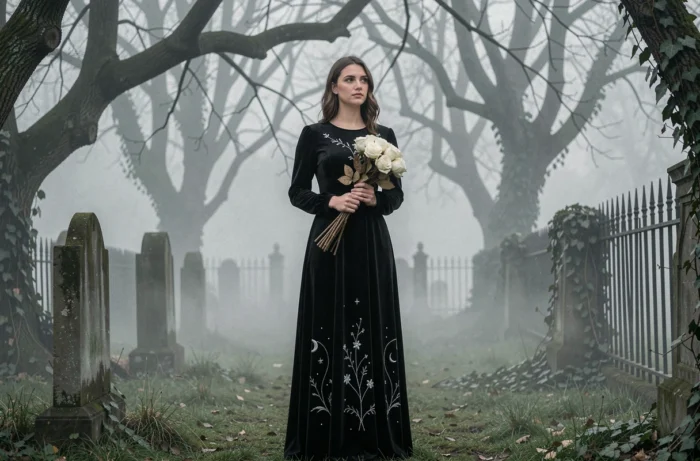
The market for esoteric accessories is no longer limited to a few pentacle-shaped pendants sold at festival stalls. Contemporary jewelry houses now incorporate astrological symbols into their permanent collections, while high-end ready-to-wear borrows its most identifiable visual codes from witchcore. This intersection of fashion and the paranormal relies on precise design and marketing mechanics, far removed from mere seasonal trends.
Astrological Jewelry and Talismans: The Regulatory Framework Brands Ignore
When a brand markets a pendant as a “protective” talisman or a piece of jewelry capable of “channeling the energy” of an astrological sign, it enters a gray area. The boundary between fashion accessory and therapeutic claim remains blurred in European regulations on commercial practices.
Pandora, with its Talisman collection, illustrates a more calibrated approach. The brand presents its astrological pieces as vectors of personal expression, not as objects with supernatural properties. The consumer chooses a symbol for the qualities they wish to project (courage, stability, intuition) rather than for a promise of protection. The talisman becomes a fashion code, not a ritual object.
This distinction is not cosmetic. Brands that attribute protective virtues to their products without disclaimers expose themselves to reports for misleading commercial practices. The high-end contemporary jewelry sector, like the designers referenced at White Bird Jewellery, treats astrology as a formal vocabulary, a repertoire of engraved and set motifs, without pseudo-therapeutic discourse.
We observe that the most commercially sustainable collections are those that clearly separate mystical narrative from product promise. Fashion trends inspired by the paranormal are regularly documented on the fashion page of Paranormal News, which catalogs these intersections between esotericism and style.
Witchcore in Ready-to-Wear: Anatomy of a Standardized Aesthetic
Witchcore has codified to the point of becoming an identifiable commercial segment. Its visual grammar relies on a limited number of combinatory elements, and it is precisely this readability that makes it an effective marketing tool for brands.
- The palette focuses on black, deep burgundy, and forest green, with matte textures (velvet, boiled wool) that absorb light rather than reflect it
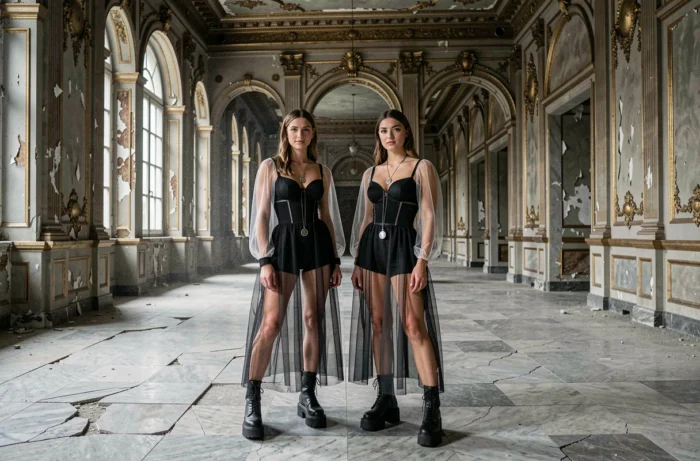
- The cuts borrow from medieval silhouettes: capes, flared sleeves, high collars, fluid high-waisted skirts, often paired with block-heeled boots
- Recurring motifs include moons, snakes, eyes, and constellations, treated in embroidery, jacquard, or screen printing
- Smoky makeup and dark hair worn loose complete the look on social media, where witchcore functions as both a photographic and fashion style
The viral phrase, “the summer of sexy girls is over, welcome to the season of witches,” summarizes the seasonal mechanics of the phenomenon. Witchcore reactivates every autumn, with a peak of interest between September and November.
The risk for brands investing in this niche lies in saturation. When every fast fashion retailer offers its “mystic” capsule with the same moon motifs on a black background, the aesthetic loses its symbolic weight. Collections that stand out are those that focus on material and cut rather than simply applying esoteric prints to basics.
Accumulation of Symbols and Mixing of Metals: Personalization as a Purchase Driver
Astrology in fashion no longer functions as a fixed classification system. Astrological signs are treated as a modular style vocabulary, where the consumer picks according to the image they want to project, not according to their birth date.
Pandora pushes this logic by designing its pieces to be combined and layered. The brand explicitly encourages the pairing of silver and gold finishes, breaking with the classic rule of a single metal. This mixing of metals and accumulation of symbolic pieces transforms esoteric jewelry into a composition system, comparable to what streetwear brands do with patches and pins.
Contemporary jewelry adopts a more artisanal approach. Designers who work with astrological motifs by hand (engraving, cloisonné enamel, setting stones associated with the signs) position their pieces in a discreet luxury register. The mystical symbol gains aesthetic legitimacy what it loses in price accessibility.
Paranormal Fashion and Brand Storytelling: The Narrative Codes That Work
Chloé set the tone by naming a collection “Hippie Modernist” and organizing a meditation session during Paris Fashion Week. Artistic director Natacha Ramsay-Levi spoke of “the story of a hippie community that wants to reinvent a new way of living.” Models wore amulet necklaces as runway accessories.
This type of staging works because it anchors the garment in a narrative. The paranormal provides a narrative framework that minimalism cannot offer. A black sweater remains a black sweater. A black sweater presented as inspired by a 16th-century grimoire acquires a symbolic value that justifies a higher price.
The most skilled brands separate three levels of discourse:
- The product itself, whose textile quality and cut must stand independently of the storytelling
- The visual universe (photographic campaigns in chiaroscuro, forest settings, candles), which creates the atmosphere without promising anything
- The brand narrative, which draws from esotericism as a source of cultural inspiration, alongside art or architecture
Collections that confuse these levels, selling an ordinary garment under the guise of mystical powers, lose credibility with an increasingly discerning audience. Paranormal fashion has a solid commercial future as long as it remains what it is: an aesthetic language, not a supernatural promise.