
A Torx key is a fastening tool designed to fit into a six-lobed, star-shaped recess. Originally developed by Camcar Textron, this geometry is known by the Torx trade name, but is also referred to as a hexalobular recess. It differs from Allen keys (hexagonal) and Phillips bits in how it distributes force during tightening.
Hexalobular geometry: what sets a Torx key apart from an Allen key
Torx and Allen keys are often confused. Both tools commonly have the same L-shaped design, but their cross-sections are radically different. An Allen key has a hexagonal profile (six flat sides), while a Torx key has six rounded, star-shaped lobes.
This difference in profile directly affects how the tool performs during tightening. With a hexagonal recess, pressure is concentrated on the edges, making the screw head more likely to round off if too much torque is applied. With a Torx recess, the rounded lobes distribute stress over a larger contact area. This reduces the risk of damaging the screw and makes torque transfer more efficient.
To learn more about Torx keys and how to use them, it is also worth noting a commonly overlooked point: not every star-shaped recess is a Torx. The Torx Plus system uses a different geometry with more angular lobes, while external star-shaped screw heads require an E-type socket, not a standard internal Torx key. Appearance alone is not enough to choose the right tool.
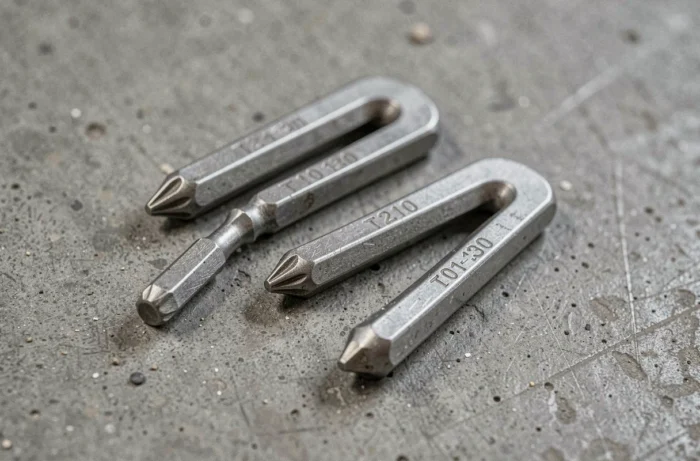
Torx key T sizes: how to read the markings correctly
Torx keys are identified by a number preceded by the letter T: T10, T15, T20, T25, T30, T40, and so on. This number indicates the size of the hexalobular recess, not the screw diameter or thread pitch. Two screws with different threads can have the same T-size recess.
This is a common pitfall when replacing a screw. Finding a T25 bit that fits correctly does not guarantee that the replacement screw will have the right mechanical specifications (length, diameter, thread pitch, material). The T-size only identifies the interface between the tool and the screw head.
How to identify the right size without forcing it
The bit should fit into the recess without noticeable play or resistance. If it goes in but wobbles in the head, it is too small. If it will not go all the way in, it is too large or the profile is not standard Torx.
A set of Torx keys covering sizes T10 to T40 is sufficient for most everyday DIY, woodworking, and light mechanical tasks. Smaller sizes (T6, T8, T9) are used for electronics and precision mechanics.
Security Torx bits and holding bits: two different functions
The term “security Torx” is often used to describe two types of bits that serve different purposes. Knowing the difference helps avoid buying the wrong one.
- Security Torx bit (Torx TR or Torx Tamper Resistant): it has a central hole that fits over the pin found at the bottom of some screws. These pin-in screws are used on public equipment, household appliances, and electronic enclosures to deter unauthorized disassembly.
- Torx holding bit: its fit holds the screw on the tool through friction. This makes it easier to work one-handed or in hard-to-reach areas where the screw needs to be positioned without holding it with your fingers.
- Torx Plus bit: designed for the Torx Plus system (with a more angular lobe geometry), it is not interchangeable with a standard Torx bit. A standard Torx bit may appear to fit a Torx Plus screw, but the contact between the surfaces will be insufficient to transfer torque properly.

Tightening with a Torx key: mistakes that damage the screw
Hexalobular geometry withstands force better than a Phillips recess, but it is not indestructible. A poorly fitting bit is still the leading cause of damage to a Torx recess.
Using a bit that is slightly too small results in partial contact with the lobes. Under pressure, the screw lobes gradually round off, making removal very difficult. The mistake is all the more insidious because the screw may appear to turn normally for the first few rotations.
Align the tool axis with the screw axis
Cam-out (the tool slipping out of the recess) is rare with a correctly sized Torx bit, but poor alignment can still cause it. The tool must remain perpendicular to the screw head throughout tightening.
When using a power screwdriver, torque control helps prevent exceeding the strength of the recess. Set the screwdriver’s torque limiter before tightening to protect both the screw and the bit. When tightening by hand with an L-shaped key, use the short arm for quick turning and the long arm to apply the final torque more precisely.
ISO 10664 describes the geometry of the internal hexalobular recess, but it is not a comprehensive manufacturing standard for tools. In practice, two T25 bits from different manufacturers may have slight tolerance variations. Checking the actual fit on the screw before applying force remains the best precaution, regardless of the marking engraved on the bit.