
You’re paying for an online purchase, and the form asks for the date printed on your card in MM/YYYY format. This four- to six-digit code is more than a simple administrative formality. It affects the validity of every transaction, the security of your data and the smooth running of your subscriptions.
Tokens and automatic updates: what happens behind the scenes when your card is renewed
When your card expires, you receive a new number, a new security code and a new expiry date. For one-off purchases, the transition is simple: you use your new card.
Recurring payments are a little more complicated. Services such as Visa Account Updater can automatically send your updated details to participating merchants. In practice, your streaming subscription or phone plan continues without you having to do anything.
Automatic updates have their limits. They depend on your bank and the merchant participating in the programme. Not all subscriptions are covered by these updates, and a recurring payment may fail without notice after your card is renewed. It’s best to check your direct debits in the weeks after receiving a new card.
There’s another technical approach: network tokens. Instead of storing your card number, the merchant keeps a tokenised payment identifier. When your details change, the token can be updated without your actual card number being shared. This provides an extra layer of protection, but it doesn’t guarantee that an account which has been blocked or closed will remain active. Understanding the MM/YYYY expiry date can help you prepare for these situations.

Transaction security: why the expiry date helps protect against fraud
The details printed or embossed on your card (number, security code and expiry date) are sensitive information. The longer a card remains in circulation, the greater the risk that someone else will gain access to these details.
Regular renewal invalidates the old details. A fraudster who has obtained your card number and security code can no longer use them once the expiry date has passed. It’s a simple but effective time-based safeguard.
The expiry date also plays a role in online purchases. It’s one of the details required to authorise a transaction, along with the card security code. Without the correct combination of expiry date and security code, the payment is declined.
Data protection and storage by merchants
You may have noticed that some websites save your card details to make future purchases easier. The CNIL distinguishes between two situations: storing data needed for a current transaction, and storing it for future purchases. Explicit consent is required for the latter.
A card’s expiry date acts as a natural expiration date for these stored details. Once the card has expired, the saved information can no longer be used, limiting the window of opportunity if a merchant suffers a data breach.
Physical wear and the evolution of bank card technology
A bank card is subject to everyday physical wear and tear. The chip wears down from friction in payment terminals. Printed characters gradually fade. The magnetic stripe (still used in some countries) deteriorates.
Regular renewal ensures that your payment card remains functional. A damaged chip can lead to in-store payments being declined, which can be particularly inconvenient abroad.
Beyond addressing wear and tear, each renewal also makes it possible to incorporate technological advances:
- Chip encryption standards evolve to counter new fraud techniques. A renewed card comes with the latest protections.
- Contactless payments were rolled out widely through successive waves of card renewals, without cardholders having to take any action.
- Manufacturing materials also change, with some banks offering more durable cards or options made from recycled materials.
The renewal cycle is therefore a discreet but powerful way to modernise the cards in circulation.
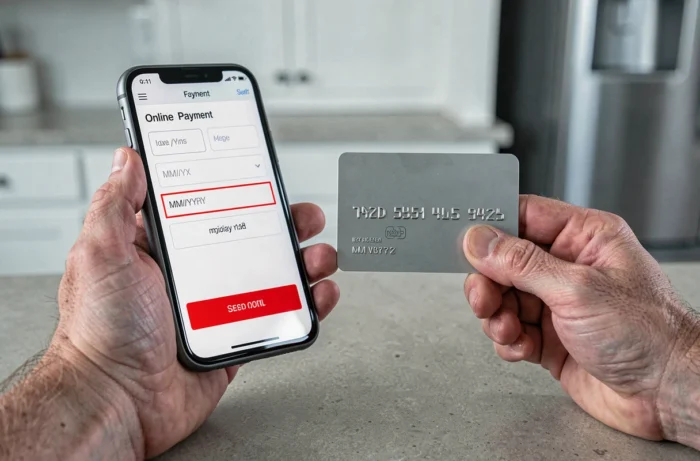
Expired card and saved payments: what you should do
Your card is about to expire. You’ll normally receive a replacement automatically a few weeks before the expiry date. To activate it, simply withdraw cash from an ATM or make a payment using your PIN.
But the main thing to consider is your saved payment details. Here’s what to check:
- Make a list of all the websites and services where your card details are saved (subscriptions, one-click purchases, tolls and parking).
- Manually update your details on platforms that aren’t covered by automatic updates. Small online merchants rarely use services such as Account Updater.
- Check your bank statements for the month after your card is renewed to spot any rejected direct debits.
- Destroy your old card by cutting through the chip and security code. Even after it expires, it still contains readable information.
When your new card doesn’t arrive
If you haven’t received your new card a week before the expiry date, contact your bank. A letter can get lost, and being left without an active payment method can cause real problems for both direct debits and everyday purchases. Some banks offer a temporary virtual card that you can use online while you wait for the physical card to arrive.
Your bank card’s expiry date is more than a cosmetic detail. It helps safeguard your payments, drives technological upgrades and sets a time limit on the use of your data. The only thing it asks of you is to update your details on a few websites when your new card arrives.